

The Toughest Page to Create
The hardest page isn't your homepage.

Quick question. Which page on your website took the most effort to create?
Homepage? Nah. You grab a template, drop in a hero section, add some testimonials. Done in an afternoon. Portfolio? That’s just arranging screenshots in a grid. Pricing page? A table and a CTA button. Not that hard.
The about page, though. That’s the one that breaks people.
I’ve built hundreds of websites over 16 years. And I can tell you, the about page is the only one where clients go silent for weeks. They’ll approve a homepage in two days. The about page? Three rounds of revisions, two existential crises, and one “can we just skip this page?” conversation. Every single time.
Here’s why it’s so hard. And what to do about it.
It demands clarity you probably don’t have yet
Every other page has a formula. Hero, features, testimonials, CTA. You can follow the template and get a B+ result. But the about page asks a fundamentally different question: who are you, and why should anyone care?
That’s not a design problem. That’s an identity problem.
Most people dodge it. They write something generic about “passion” and “excellence” and “our mission is to empower.” The result? A page that sounds like every other about page on the internet. Which means it says nothing. I’ve seen this pattern on literally hundreds of client sites. The homepage gets a custom illustration and three rounds of copywriting. The about page gets a stock paragraph and a team grid.
Here’s the thing... the about page is often the second or third most visited page on any website. On my own site, it gets more traffic than my blog index. People who land on your homepage and find you interesting? Their next click is your about page. And that’s where you’re serving them a template.
The five elements that actually work
I rebuilt my own about page recently. It’s not perfect (I’ll be the first to say that), but here’s what I’ve learned works across my own site and client projects:
1. Lead with what you solve, not who you are. Your visitor doesn’t care about your journey. Not yet. They care about their problem. Open with that. “I help WordPress agencies ship faster” beats “I’m a passionate developer with 16 years of experience” every time. The first one answers their question. The second one answers yours.
2. One photo. Real. Recent. Not a stock photo of someone in a blazer shaking hands. Not a headshot from 2019 when you had different hair. People want to see who they’re dealing with. A genuine, recent photo builds more trust in 0.3 seconds than 500 words of copy. I’ve A/B tested this on client sites. Pages with real photos convert 15-25% better on contact form submissions than pages without.
3. Specifics over adjectives. “I’ve worked with 90+ brands including IBM, Adobe, and HubSpot” hits differently than “I’ve worked with leading companies.” Name them. Numbers and names are what people remember. “Built 800+ websites” is a fact. “Extensive experience” is noise.
4. Match the page to your scale. This is where most people get it wrong. A solo freelancer’s about page shouldn’t read like a Fortune 500 “Our Team” section. And a 50-person agency shouldn’t have a page that says “Hi, I’m Dave.” Your about page needs to match who you actually are right now.
Here’s a rough framework:
Solo freelancer/creator: First person. One photo. Your story, your process, your values. Keep it under 500 words.
Small agency (2-10 people): “We” voice. Founder story plus team highlights. Show your process. 500-800 words.
Larger company (10+): Mission-driven. Team grid with real bios (not “John loves hiking and coffee”). Culture section. 800-1,200 words.
Personal brand/educator: This is the hardest one. You need vulnerability without oversharing. Professional credibility without resume-dropping. The trick? Lead with one specific story that shows why you care about what you teach.
5. Personal, but calibrated. Share your work philosophy. Share what frustrates you about your industry. Maybe mention what you do outside work in one sentence. But don’t write your autobiography. This isn’t therapy. It’s a trust signal.
The line is: would you say this to someone at a conference who just asked what you do? If yes, it belongs on your about page. If it’s something you’d only tell a close friend, it doesn’t.
What to skip entirely
A few things I see on about pages that actively hurt trust:
Timeline/milestone sections. “2010: Founded company. 2012: First client. 2015: Moved to bigger office.” Nobody reads these. They’re filler.
Generic values. “Innovation. Integrity. Excellence.” If your competitors could copy-paste the same values, they aren’t values. They’re wallpaper.
The team photo where everyone is laughing. You know the one. Arms crossed or staged laughter in front of a white wall. Get candid shots from actual work sessions.
Mission statements written by committee. “We strive to deliver best-in-class solutions that empower businesses to achieve their full potential.” I fell asleep writing that.
The real test
Read your about page out loud. If it sounds like it could belong to anyone in your field, rewrite it. The whole point of an about page is that it could only belong to you.
If you swap the name and photo and it still works for your competitor... you’ve written a template, not an about page.
WordCamp Asia 2026 in Mumbai
WordCamp Asia is happening right now in Mumbai (April 9-11) at the Jio World Convention Centre in Bandra-Kurla Complex. 3,000+ attendees. Matt Mullenweg keynoting. Rahul Bansal from rtCamp, Himani Kankaria, and a bunch of other speakers I respect are presenting across tracks on AI, enterprise WordPress, and developer workflows.
I had plans to go. Genuinely wanted to be there. But prior commitments meant I couldn’t make it, and I’m honestly a bit gutted about that. Mumbai is one of my favorite cities, and WordPress events in India have a different energy. The conversations that happen over chai breaks are often more valuable than the talks themselves.
If you’re there, enjoy it. Take it in. Talk to people you wouldn’t normally talk to. And if someone does a good talk on block theme development or the Interactivity API, tell me about it.
The rupee at 92+, and what it means for us
OK, I need to talk about this. Because it’s affecting every Indian freelancer and developer I know, and nobody’s discussing it openly.
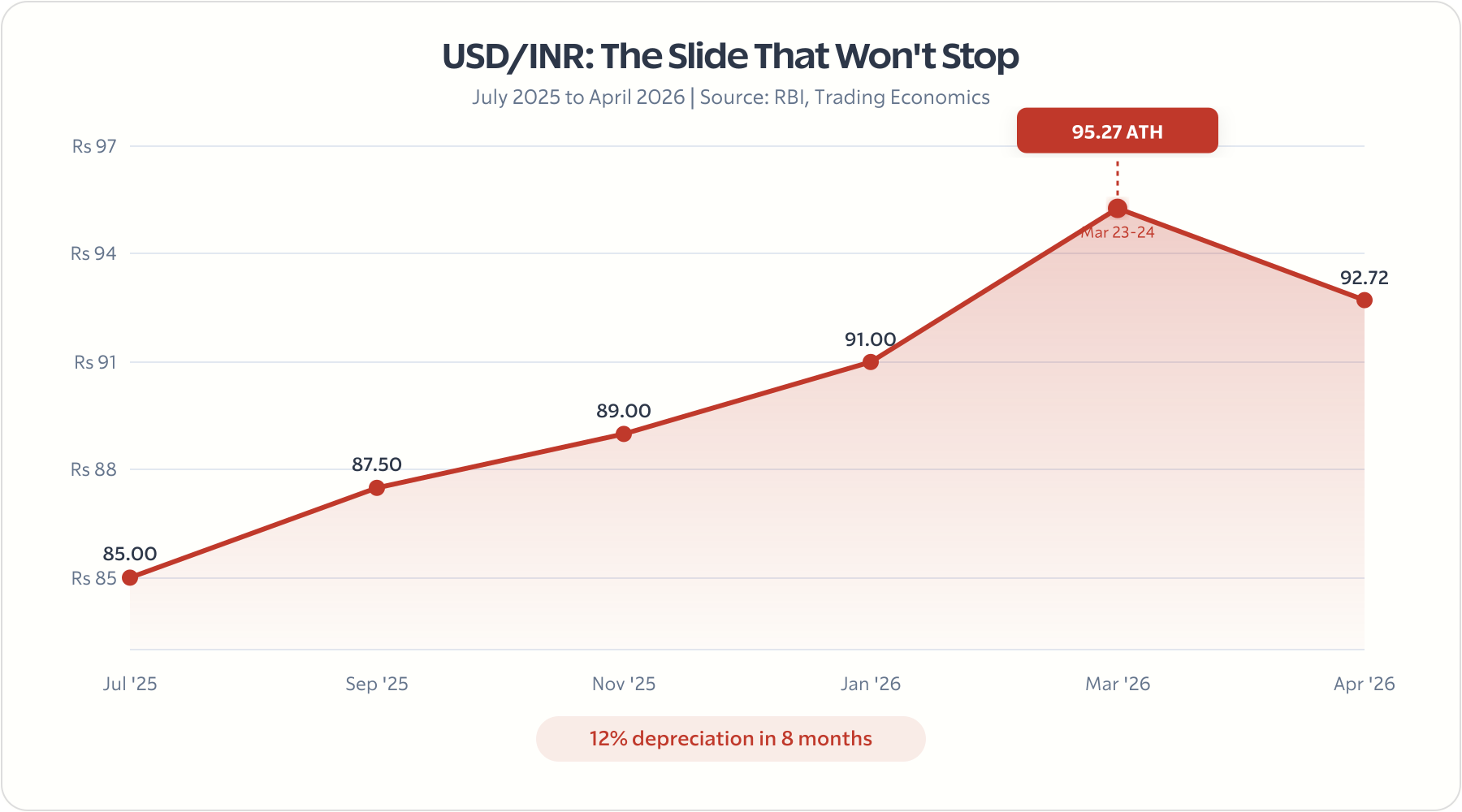
The numbers. The US dollar is at Rs 92.72 against the Indian rupee as of today. In July 2025, it was Rs 85. It reached an all time high of INR 95.27 on 23rd-24th March 2026. That’s a 12% depreciation in 8 months. The rupee was Asia’s worst-performing currency in 2025, sliding from 85 to 91 by December.
While it is now under Rs. 93/USD - analysts are projecting fixed 95+ by late 2026.
What drove it here. Three forces, all hitting at the same time:
US tariffs on Indian goods. The Trump administration slapped 50% tariffs on Indian imports. That crushed export competitiveness and widened the trade deficit.
Foreign investor exit. FIIs pulled out $18 billion from Indian equities in 2025. Rs 1,70,940 crore worth of selling. When foreign money leaves, it converts rupees back to dollars. More dollar demand, weaker rupee.
RBI policy shift. The new RBI Governor Sanjay Malhotra took a “restrained approach” to defending the rupee in late 2025. Markets read that as a green light. The controlled slide became an uncontrolled one.
Add oil prices to this (India imports 85% of its crude in USD), and you’ve got a currency under pressure from every direction.
Why this matters if you’re a freelancer. Here’s the math. A $100/month SaaS subscription cost you Rs 8500 in July 2025. In March? Rs 9527. That’s Rs 1027 more per month. Rs 12,324 more per year. For the exact same product. Same features. Same support. Nothing changed except the currency math.
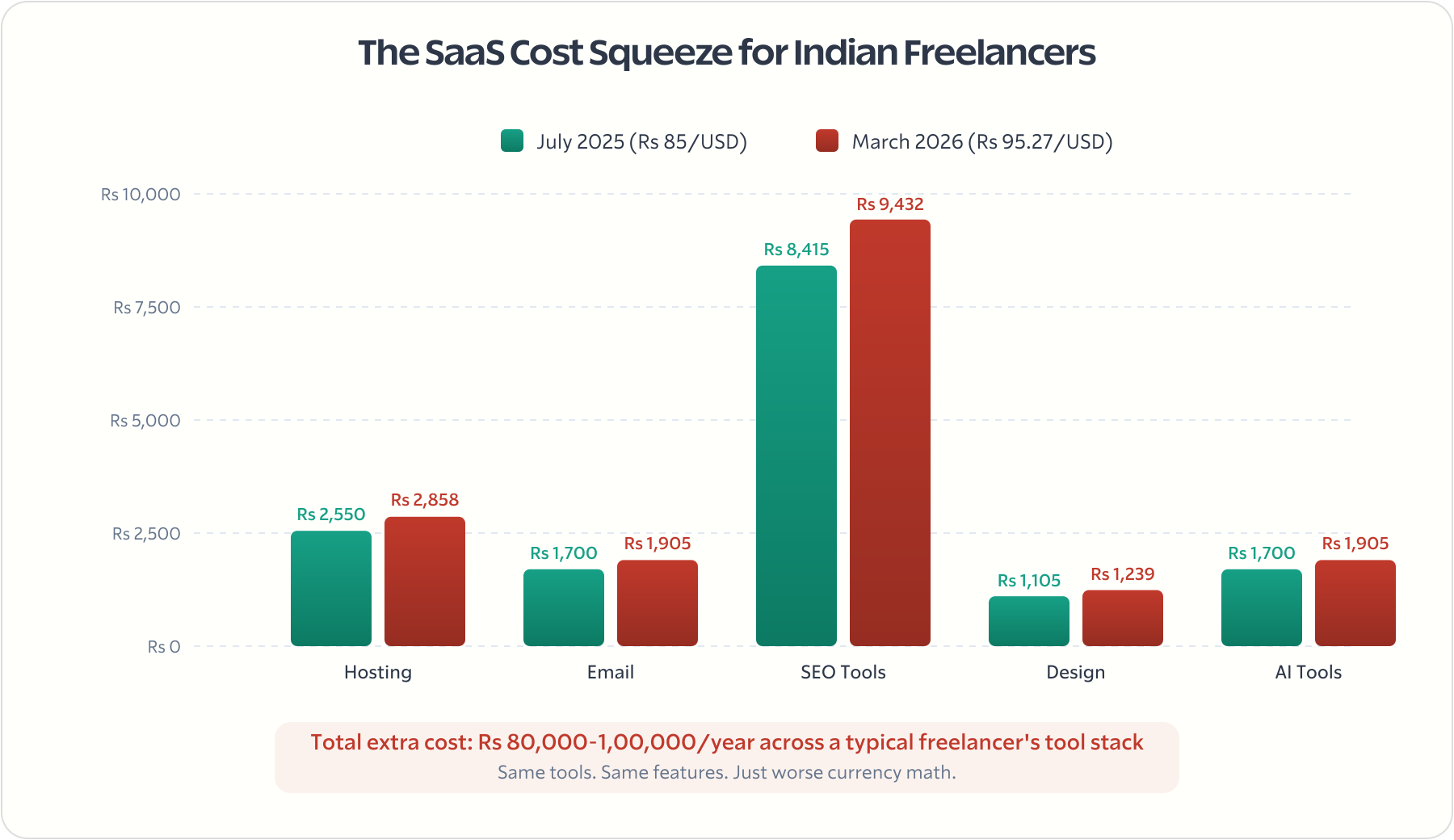
Stack that across 5-10 tools (hosting, email, analytics, SEO, design, project management), and you’re looking at Rs 80,000-100,000 extra per year just from the exchange rate. That’s not a rounding error. That’s a year’s rent in many Indian cities.
And most SaaS companies? They don’t care. A $99/year WordPress plugin costs the same whether you’re in San Francisco or Jaipur. The PPP factor for India vs the US is roughly 0.3, meaning a $100 product should theoretically cost about $30 in purchasing power terms. Some indie SaaS companies get this (tools like Parity Deals and Dodo Payments are making PPP pricing easier to implement). But the big players? Claude, GitHub, Figma, AWS? They price globally and don’t look back.
What I’m doing about it. I’ve stopped buying products priced in US dollars unless there’s genuinely no alternative. I’m going local where I can. Open source where I can. And being a lot more deliberate about what I actually need versus what’s just nice to have.
This isn’t just frugality. It’s a strategy. The Indian freelance platform market is projected to grow from $265 million in 2025 to $1.54 billion by 2033. That’s a 25% CAGR. The opportunity is real. But the people who’ll capture it are the ones who figure out how to reduce their USD-denominated costs while maintaining output quality. That’s the competitive edge nobody’s talking about.
For those of us earning in dollars from international clients, there’s a silver lining. The same $1,000/month that converted to Rs 83,000 in 2023 now (at the time of writing) converts to Rs 92,720.
But if you’re earning in rupees and paying in dollars... you’re getting squeezed from both sides. And that squeeze is going to get worse before it gets better.
In the next issue, I'll be breaking down the exact structure of my about page, element by element, and what I'd change if I rebuilt it today. Reply if you've got an about page you're stuck on. I'll take a look.
Until next time.